


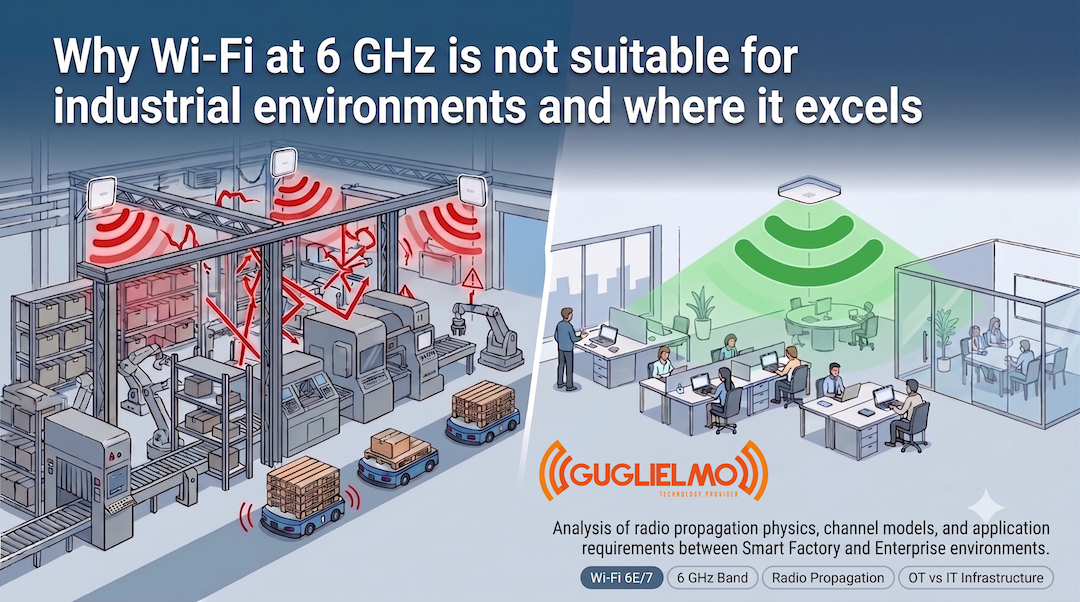
Why 6 GHz Wi-Fi is unsuited for industrial environments and where it performs best
An Analysis of Radio Propagation Physics, Channel Models, and Application Needs Between Smart Factories and Enterprise Environments
In recent years, the introduction of the Wi-Fi 6E standard and the very recent Wi-Fi 7 (IEEE 802.11be) has unlocked access to the new 6 GHz frequency band (5.925 GHz – 7.125 GHz). The enthusiasm surrounding this band is largely justified by the massive availability of unexplored electromagnetic spectrum: up to 1200 MHz of contiguous spectrum that allows the allocation of ultra-wide channels (up to 160 MHz and 320 MHz) completely free from interference with legacy devices.
However, a dangerous misconception is spreading among IT managers and OT (Operational Technology) systems engineers: the belief that the 6 GHz frequency should be implemented indiscriminately to modernize all networks, even in manufacturing and logistics areas.
The reality of radio propagation physics demonstrates the exact opposite. While the 6 GHz band delivers extraordinary performance in offices and residential settings, it very often proves to be an ineffective—and in some cases even counterproductive—choice in industrial environments (manufacturing plants, automated warehouses, logistics hubs).
The first and most obvious reason why a 6 GHz signal is unsuitable for large industrial footprints lies in the fundamental principles of electromagnetism: as frequency increases, path loss in space increases non-linearly. Assuming a typical distance between the Access Point and the client in industrial networks (>15m), this results in significant additional attenuation, which decisively lowers the received signal level.
Furthermore, in manufacturing contexts, the wireless signal rarely travels under perfect line-of-sight conditions (NLoS – Non-Line-of-Sight). The very structure of industrial buildings presents impenetrable or highly reflective obstacles: high-density metal racking, machinery, overhead cranes, fluid tanks, and steel piping. This leads to three typical issues that predominantly affect high-frequency signals: lower diffraction capability—meaning the signal cannot “bend around” obstacles through diffraction—high material attenuation (ITU-R P.2040-4 recommendations), and above all, extreme multipath phenomena with destructive interference, caused by metallic surfaces that easily reflect high-frequency waves.
Finally, there are major operational criticalities regarding roaming and real-time OT protocols for fast-moving clients (e.g., AGVs). In Industry 4.0 plants, the fundamental priority of the Wi-Fi network is not aggregate throughput in Gbps, but deterministic latency (bounded jitter), signal uniformity, and zero packet loss for industrial protocols. Because 6 GHz radio coverage naturally spans a very small radius, covering a 10,000 m² industrial facility would require installing between 100% and 250% more Access Points compared to a design based on 5 GHz or 2.4 GHz, respectively; consequently, high AP density poses a critical problem for fast-moving clients like automated guided vehicles (AGVs, AMRs) and operators with handheld devices. In fact, a moving vehicle would have to disconnect and reconnect to a new Access Point every few meters, and each handoff procedure (IEEE 802.11r/k/v roaming) takes between 20 and 100 milliseconds. Overly frequent roaming events exponentially increase the probability of packets loss, causing immediate stops of automated vehicles and halting the production line.
While the 6 GHz frequency exhibits clear limitations on production floors, it excels incomparably in environments such as corporate offices, residential areas, schools, and universities. The reason lies in the perfect alignment between the requirements of these spaces and the nature of the signal. High wall attenuation actually becomes a strategic advantage in office settings. It reduces co-channel interference between adjacent rooms or apartments, allowing the same frequencies to be reused over short distances without noisy overlaps. Additionally, in high-density static client scenarios—such as a conference room or an open-space office with dozens of laptops and smartphones conducting video calls and massive data transfers—the wide 80 MHz and 160 MHz channels of the 6 GHz band provide unprecedented bandwidth. Last but not least is client modernization: the absence of older standards (Wi-Fi 4/5) on the 6 GHz band eliminates management overhead, making the network responsive and efficient.
Comparison Matrix
|
Feature |
Industrial Environment (OT) | Office / Enterprise (IT) |
| Key Requirement | Ultra-low latency, Seamless roaming, Continuous coverage | High throughput, High user density |
|
Recommended Band |
5 GHz (Clients) / 2.4 GHz (Sensors/IoT) | 6 GHz (Clients) / 5 GHz (Clients) |
|
Obstacle Impact |
Critical (Metal shielding, Multipath) | Mild (Partition walls, Drywall) |
| AP Planning | Large cells, controlled overlap for roaming | High-capacity, concentrated micro-cells |
Academic References, Standards, and Authoritative Sources
- IEEE Standard 802.11ax-2021 / IEEE 802.11be (Wi-Fi 7): IEEE Standard for Information Technology – Telecommunications and Information Exchange between Systems – Specifications for physical and MAC layer operation in the 5.925–7.125 GHz band.
- ITU-R Recommendation P.2040-4 (09/2025): Effects of building materials and structures on radio-wave propagation in the range of 1 MHz to 450 GHz – International Telecommunication Union (ITU), Geneva.
- ITU-R Recommendation P.1238-11: Propagation data and prediction methods for the planning of indoor radiocommunication systems and radio local area networks in the frequency range 300 MHz to 450 GHz.